
















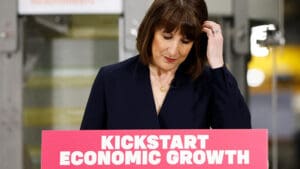

The UK’s long-running “risk premium” in financial markets appears to be unwinding, with economists claiming investors are regaining confidence in Rachel Reeves’ fiscal strategy — and that the shift could save taxpayers billions of pounds over the next five years.
New analysis from the Institute for Public Policy Research (IPPR), a think tank with longstanding ties to Labour, shows gilt yields have fallen faster than those in the US and eurozone since September. The move follows a turbulent year in which UK borrowing costs climbed significantly above other G7 economies, fuelled by persistent inflation, weak growth, and speculation over the new government’s tax plans.
According to the IPPR, yields on UK government bonds have dropped by 0.2 percentage points more than their American and eurozone equivalents over recent months. While modest, the reversal is viewed as a meaningful sign that Reeves’ public embrace of strict fiscal rules, first restated at Labour conference — has reassured money markets jittery since Liz Truss’s mini-Budget in 2022.
Earlier this year, the gap between UK and US 10-year bond yields had blown out to 1.1 percentage points; against eurozone debt, the margin was 0.6 points. On 30-year bonds the divergence was even starker, hitting 1.5 points versus US treasuries. Those differences amounted to a clear “risk premium”, a financial penalty imposed on the UK for political unpredictability and concerns over fiscal credibility.
“The reasons for this premium are not straightforward, especially given that the UK’s fundamentals are stronger than many countries with lower borrowing costs,” the IPPR noted, highlighting Britain’s debt-to-GDP ratio of around 100%, lower than that of the US, Italy or Japan.
Senior Bank of England officials echoed the assessment. Deputy governor Sir Dave Ramsden told MPs on the Treasury committee that gilt market volatility ahead of Reeves’ Budget was noticeably lower than in comparable pre-Budget periods under the previous Conservative government.
“There were no concerns about financial stability,” he said, a marked contrast to the gilt market crisis triggered by Truss’s unfunded tax cuts.
The Bank now expects the Budget to shave up to 0.5 percentage points off inflation next year, thanks largely to Reeves’ decision to remove taxes from household energy bills. Inflation currently sits at 3.6%.
Despite the recent improvement, UK borrowing costs remain elevated by historical standards and are still higher than those faced by the US or eurozone members. The Office for Budget Responsibility forecasts that debt interest payments will exceed £100 billion in every year of this parliament.
However, if the remaining risk premium disappears, the IPPR calculates that taxpayers could save up to £7 billion a year by 2029–30, money that could otherwise be directed to public services or debt reduction.
Carsten Jung, associate director for economic policy at the IPPR, said a “clear, credible” fiscal path could make the UK “a star performer in the G7”, but warned that the Bank of England could undermine progress if it continues its aggressive quantitative tightening programme.
The Bank estimates its bond disposals have pushed up gilt yields by as much as 0.25 percentage points. Jung said the Bank should “pull its weight” and pause sales to avoid unnecessarily driving up borrowing costs at a time when the government is trying to restore stability.
Bond yields have also been kept higher by falling demand from final-salary pension schemes, once major institutional buyers of long-dated gilts.
For now, though, the message from the markets appears clearer than it has been for years: after a volatile 18 months, investors may finally believe that the UK has rediscovered its fiscal discipline.
Read more:
Falling gilt yields suggest Rachel Reeves has ‘won back market confidence’